


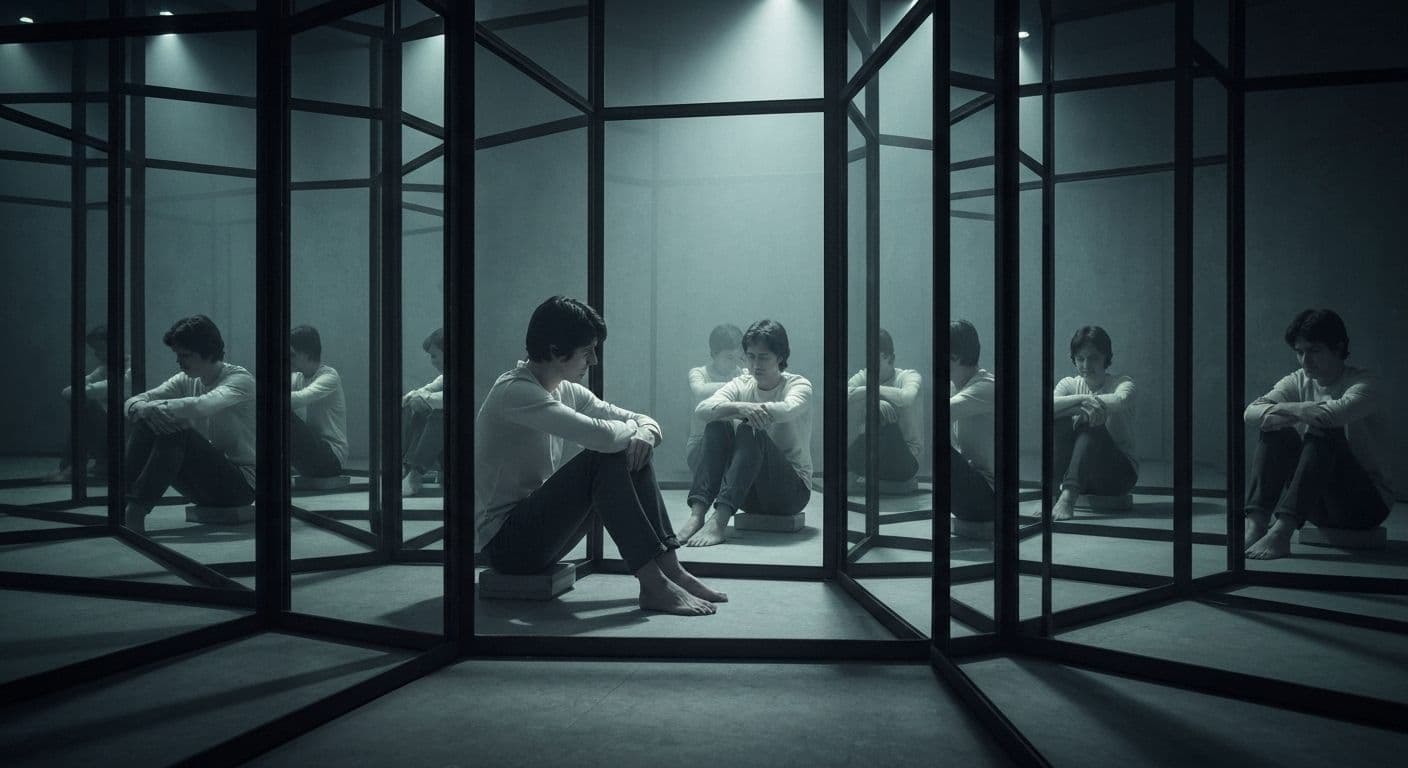
Extreme Self Awareness Anxiety: Why Watching Yourself Creates Stress
You're at dinner with friends, and suddenly you're not really there anymore. Instead, you're watching yourself be there—analyzing your laugh (was it too loud?), monitoring your facial expressions (do I look interested enough?), and replaying every sentence you just said. This exhausting mental surveillance isn't self-improvement; it's extreme self awareness anxiety, and it's turning your brain into a 24/7 critic that never clocks out.
Here's the paradox: the more intensely you try to understand and control yourself, the more anxious and disconnected you become. Extreme self awareness anxiety operates like having a judgmental documentary crew following your every move, except the camera is inside your head and it never stops rolling. What feels like gaining insight is actually depleting the mental resources you need to actually live your life. This constant self-monitoring promises clarity but delivers exhaustion instead.
The irony? Your brain has limited attention capacity, and extreme self awareness anxiety is consuming most of it on surveillance rather than experience. Let's explore why constantly watching yourself creates more stress than calm, and how to redirect that attention toward anxiety management that actually works.
How Extreme Self Awareness Anxiety Hijacks Your Brain's Resources
Your brain operates with a finite amount of attention—think of it as cognitive bandwidth. When extreme self awareness anxiety takes over, you're essentially running two demanding programs simultaneously: experiencing your life and critiquing your experience of it. This double-processing creates massive cognitive load that leaves you mentally exhausted by the end of each day.
The science behind this is straightforward: your prefrontal cortex, responsible for self-reflection and monitoring, becomes overactive while competing with the same neural resources needed for natural social interaction, decision-making, and emotional regulation. It's like trying to drive while constantly checking your rearview mirror—you're so focused on watching yourself that you miss what's actually happening on the road.
This creates a particularly vicious feedback loop. You notice you're anxious, which makes you monitor yourself more closely to control the anxiety, which increases your self-consciousness, which amplifies the anxiety. The brain's response to stress compounds when you're both experiencing anxiety and anxiously watching yourself experience anxiety.
Consider this concrete example: You're trying to "act natural" during a presentation, but because you're hyper-aware of trying to act natural, your gestures become stiff, your voice sounds forced, and you forget what natural even feels like. The surveillance itself creates the awkwardness you're trying to avoid. This is extreme self awareness anxiety in action—the observer effect destroying authentic experience.
The Difference Between Healthy Self-Reflection and Extreme Self Awareness Anxiety
Not all self-awareness is problematic. Healthy self-reflection involves periodic, intentional check-ins where you review experiences with curiosity and constructive purpose. You might think after a meeting, "What went well? What could I improve next time?" This reflection happens at designated times, with specific goals, and a supportive internal tone.
Extreme self awareness anxiety, by contrast, is constant, automatic, and relentlessly critical. It doesn't wait for appropriate moments—it runs continuously in the background like invasive spyware. While healthy reflection asks, "What can I learn?" constant surveillance demands, "What's wrong with me right now?"
The timing difference is crucial. Healthy self-reflection happens after events, allowing you to process with perspective. Extreme self awareness anxiety hijacks the present moment, forcing you to simultaneously live and judge your living. It's the difference between reviewing game footage after the match versus having a critic screaming in your ear during every play.
The emotional quality differs dramatically too. Reflection approaches your experiences with curiosity and growth-mindedness, similar to building self-trust over time. Surveillance approaches with suspicion and judgment, constantly scanning for flaws and mistakes. One leads to insights and improvements; the other creates paralysis and anxiety.
Breaking Free from Extreme Self Awareness Anxiety Through Outward Focus
The antidote to extreme self awareness anxiety isn't more intense self-analysis—it's deliberately redirecting your attention outward. When you shift focus from internal surveillance to external engagement, you interrupt the exhausting cycle of self-monitoring and reclaim your cognitive resources for actual living.
Ready to try a powerful attention-shifting technique? The 5-4-3-2-1 sensory grounding method pulls you out of self-surveillance and anchors you in present experience. Identify 5 things you can see, 4 you can touch, 3 you can hear, 2 you can smell, and 1 you can taste. This simple practice redirects your brain's attention from internal criticism to external reality, providing immediate relief from extreme self awareness anxiety.
When you fully engage with external experiences—really listening to someone speak, noticing the texture of your coffee cup, feeling your feet on the ground—there's simply less bandwidth available for the internal surveillance channel. Your brain can't simultaneously critique your listening and actually listen deeply. The more absorbed you become in outward experience, the quieter the internal observer becomes.
Here's a liberating truth: you don't need to watch yourself to be yourself. Your authentic responses emerge more naturally when you're not constantly checking and editing them. Trust that you can interact, decide, and respond without a vigilant overseer monitoring every micro-expression and word choice. This trust develops through small changes that gradually reduce your reliance on constant self-monitoring.
Breaking free from extreme self awareness anxiety means reclaiming your attention as a resource for engagement rather than surveillance. The goal isn't eliminating self-awareness—it's right-sizing it, placing it in service of growth rather than anxiety. You deserve to experience your life directly, not through the exhausting lens of constant self-judgment.



