


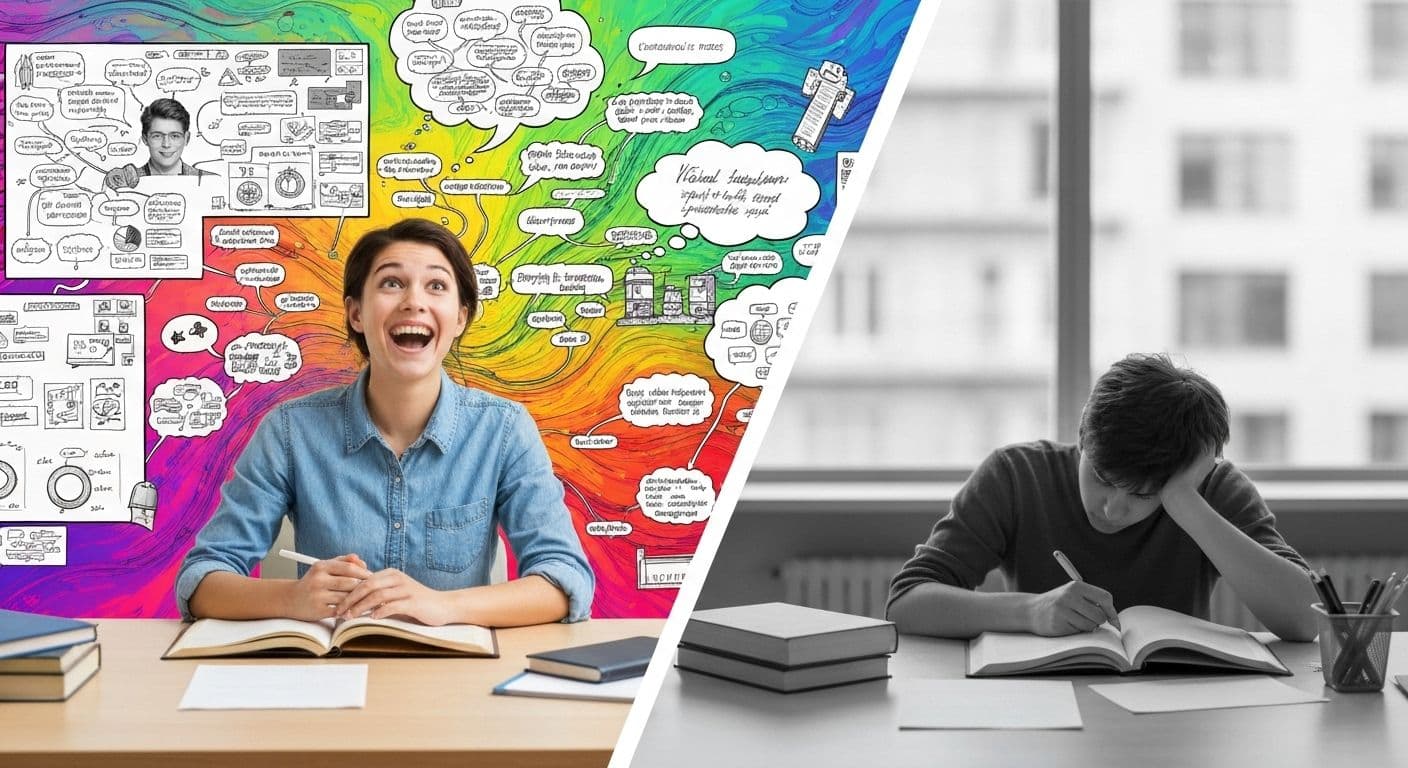
Why 16 Habits of Mind Beat Traditional Study Methods for Visual Learners
If you're a visual learner, you've probably felt the frustration of sitting through lectures packed with verbal explanations or staring at dense textbooks that just don't click. Traditional study methods often miss the mark for people who think in pictures, patterns, and spatial relationships. Here's the good news: the 16 habits of mind provide a framework that works with your visual brain, not against it. These cognitive dispositions translate naturally into visual tools like mind maps, color-coded systems, and spatial organization strategies that help you retain information more effectively.
Visual learners face unique challenges with traditional study methods because their brains process information differently. While conventional approaches rely heavily on reading, listening, and verbal repetition, visual thinkers need to see connections, patterns, and relationships. The 16 habits of mind offer something different—a set of thinking behaviors that you can transform into concrete visual systems. When you apply these habits through visual techniques, you're working with your brain's natural strengths rather than fighting them. Research shows that visual learners who align their study methods with their processing style retain information significantly better than those using mismatched approaches.
Understanding how the 16 habits of mind connect to your visual learning style creates a powerful advantage in both academic and professional settings. These habits become more than abstract concepts—they transform into tangible tools you can see, organize, and manipulate spatially. Ready to discover how these cognitive dispositions can revolutionize your learning experience?
How the 16 Habits of Mind Align with Visual Learning Patterns
Striving for accuracy takes on new meaning when you're a visual learner. Instead of simply double-checking written work, you create color-coded verification systems where different colors represent different types of information. Visual accuracy strategies might include creating comparison charts that let you spot discrepancies at a glance or using spatial arrangements to verify logical sequences. Your brain naturally notices when visual patterns don't align, making this habit particularly powerful.
Thinking about thinking—what experts call metacognition—becomes remarkably effective for visual thinkers when you map your thought processes. Create visual reflection diagrams that show how you approached a problem, what worked, and what didn't. Mind mapping your metacognitive process helps you see patterns in your thinking that would remain invisible through verbal reflection alone. This visual approach to understanding personal growth transforms abstract self-awareness into concrete, observable patterns.
Applying past knowledge to new situations becomes clearer when you create visual timelines and comparison charts. Visual learners excel at spotting connections when they can see multiple concepts simultaneously. Draw parallel timelines showing how historical events relate, or create matrix diagrams that compare and contrast different theories. These spatial representations help your brain recognize patterns and relationships that traditional note-taking methods obscure.
Managing impulsivity transforms through visual planning boards and spatial decision-making frameworks. When you create a visual representation of your options, consequences, and decision points, your brain naturally pauses to process the information. This spatial approach to overcoming impulsive decisions gives visual thinkers the processing time they need without feeling restricted by verbal rules or written checklists.
Practical Visual Techniques for Each of the 16 Habits of Mind
Transform persistence into something you can see and measure. Create visual progress trackers that show your learning journey spatially—think milestone maps with color-coded achievements, visual timelines showing how far you've come, or progress bars for complex projects. When you can see your persistence paying off visually, maintaining momentum becomes significantly easier.
Convert listening with understanding into sketch notes and visual summaries. Instead of writing linear notes, capture key concepts in diagrams, icons, and spatial arrangements. This technique leverages your visual learning style while building the habit of truly understanding rather than just recording information. Your sketch notes become a personalized visual language that makes sense to your brain.
Turn questioning and problem posing into visual inquiry boards. Create branching question trees that show how one question leads to another, or design spatial problem frameworks that organize complex challenges into manageable visual chunks. These 16 habits of mind strategies help visual learners engage more deeply with material by organizing their curiosity spatially.
Make thinking flexibly tangible through multiple visual representations. Take the same concept and express it using different colors, shapes, and spatial arrangements. Create a mind map, then transform it into a flowchart, then into a color-coded matrix. This practice of adapting to different perspectives strengthens cognitive flexibility while honoring your visual processing strengths.
Implementing the 16 Habits of Mind into Your Visual Learning Practice
Start with three core habits from the 16 habits of mind that resonate most with your visual learning style. Build visual systems around these habits first before expanding to others. This focused approach prevents overwhelm and lets you develop strong visual frameworks that actually work for your brain.
Create a visual habit tracker showing which of the 16 habits of mind you're actively using in your daily learning. Use color coding, icons, or spatial arrangements to make your habit development visible and trackable. This metacognitive tool helps you notice patterns in which habits you naturally gravitate toward and which ones need more attention.
Combine multiple habits into integrated visual frameworks that support complex learning tasks. For example, merge striving for accuracy with thinking flexibly by creating color-coded mind maps that show multiple perspectives while maintaining visual verification systems. The science shows visual learners retain information 65% better when cognitive habits align with their visual processing strengths.
Ready to transform your learning? The Ahead app helps you build these 16 habits of mind with personalized visual tools designed for how your brain actually works, making it easier to develop the thinking patterns that lead to lasting success.



